Why Your Grandkid's Pediatrician Won't Tell You to Throw Out Your Clorox Wipes (But She's Thinking It)
A Wall Street Journal study just confirmed what grandmothers who clean with vinegar have been saying for forty years. And why the makers of cleaning products don't care to change. (But one brand has)
If you've ever stood at your kitchen counter with a Clorox wipe in your hand, paused for half a second, and thought "I should probably rinse this off before the baby touches it," your instinct was right. Your pediatrician just isn't allowed to say so out loud.
Here's what's quietly happening in pediatric medicine right now. Doctors are increasingly seeing kids with chronic conditions that didn't show up in their grandparents' generation. Eczema. Persistent allergies. Asthma. Skin sensitivities that don't respond to anything.
The Wall Street Journal published a piece this April written by a molecular biologist named Nathan Shatz. His core finding, after sequencing the skin microbiomes of more than 150 young people, was shocking:
+70%
Increase in childhood allergy rates since the late 1990s.
SOURCE: U.S. CDC, REPORTED IN THE WALL STREET JOURNAL, APRIL 2026
Four Things in Your Wipes That Your Grandkids' Bodies Are Reacting To
PROBLEM 1: QUATERNARY AMMONIUM COMPOUNDS (QUATS)
The ingredient linked to childhood asthma, is in nearly every wipe on the shelf.

Quats are an EPA-registered pesticide and are in most major wipe brands. They've been linked to asthma and respiratory irritation in peer-reviewed studies. Healthcare workers wear gloves to handle them. The rest of us have been wiping the high chair with them.
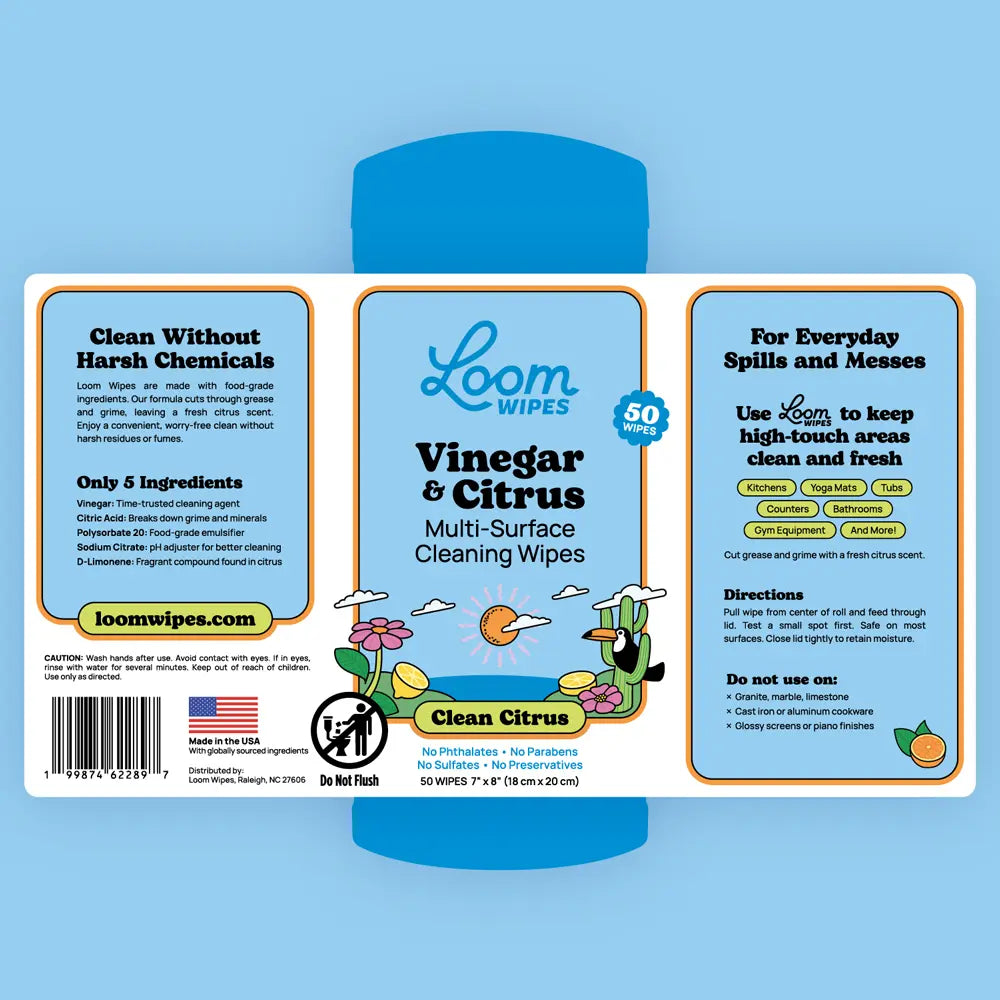
Loom Wipes clean with vinegar, the same thing you’ve used for years. No quats, no harsh chemicals, no need to rinse after cleaning.
PROBLEM 2: UNDISCLOSED FRAGRANCE BLENDS
"Fragrance" can legally hide hundreds of chemicals, and your grandkid's eczema knows it.
Under U.S. law, the word "fragrance" can include any of more than 3,000 different chemical compounds, and the manufacturer is not required to tell you which ones. Many of them are well-documented skin sensitizers and allergens. If your daughter has ever said "she breaks out when we visit," this is one of the reasons.
Loom Wipes use D-limonene, a real citrus compound. That's the entire fragrance story. No hidden blends.
PROBLEM 3: The leftover chemical residues
Read the back of your disinfectant wipes. It tells you to rinse surfaces. (Most people don't)
The label on Clorox Wipes explicitly instructs the user to rinse food-contact surfaces with potable water after use. Almost no one does. The result is a thin chemical residue on the surface your toddler eats off of, your dog licks, and your grandkid's hands touch all day long.
Why Loom doesn't need a rinse step? Five ingredients, all of them food-grade Wipe and walk away.
PROBLEM 4: disinfecting overkill
Disinfectants are being overused by 50% of American households.
The CDC data isn't ambiguous: childhood allergies have risen 70% since the late 1990s. The over-sanitized environment is one of the leading suspected causes. Stripping the surfaces around children of every microbe, instead of cleaning them sensibly, is one of the things researchers now actively warn against.
Why Loom is different: Vinegar cleans. It doesn't sterilize the surface down to a hospital floor. That's the point.
The Generational Data Pediatricians Are Actually Looking At
Last month, the Wall Street Journal published a first-person piece by Nathan Shatz, a Michigan-trained molecular biologist and co-founder of a microbiome research company called Milieu. He spent a semester sequencing the skin microbiomes of more than 150 college students and what he found tracked exactly with the emerging clinical literature:
"Bacterial ecosystems stripped of their diversity, reduced to a fraction of what published data describes as healthy. The science had hinted at a generational decline in skin microbiome health. My data seemed to confirm it."
- Nathan Shatz, WSJ, April 2026
He went on to identify the suspected drivers: shelf-stable processed food, unnecessary antibiotics, and (directly quoted) "the products on our bathroom shelves, marketed as clean," that stripped away the bacteria his generation needed.
You already knew this. You've been cleaning with vinegar since before half of these studies existed. The science just took forty years to catch up to what your gut was telling you.


Vinegar & Citrus Natural Cleaning Wipes
Vinegar & Citrus Natural Cleaning Wipes
Vinegar cleaning wipes made with just 5 food-grade ingredients. No harsh chemicals, residues, or fumes.
- Gentle Effective Clean
- Safe Around Kids & Pets
- Natural Citrus Scent
- Clean Ingredients
Couldn't load pickup availability
- Free Shipping
 Made in the USA
- 30 Day Guarantee

Details
Details
The Wipe
Each wipe is 7" x 8", large enough to
tackle messes without using multiple wipes. The textured material is
durable enough to scrub dried-on food without tearing or falling apart.
Ingredients
Vinegar, Citric Acid, Polysorbate 20, Sodium Citrate, D-Limonene
Made without
Phthalates, parabens, sulfates, preservatives, ammonia, chlorine, or bleach.
Directions
Directions
Directions
Pull wipe from center of the roll and
feed through lid. Test a small spot first. Safe on most surfaces. Close
lid tightly to retain moisture.
Do not use on
Granite, marble, limestone, cast iron or aluminum cookware, glossy screens, or piano finishes.
Safe around kids and pets when used as directed.